
By Anthony Ménard, updated on November 10, 2026
Low-code development for an SME: costs, limitations, thresholds 2026
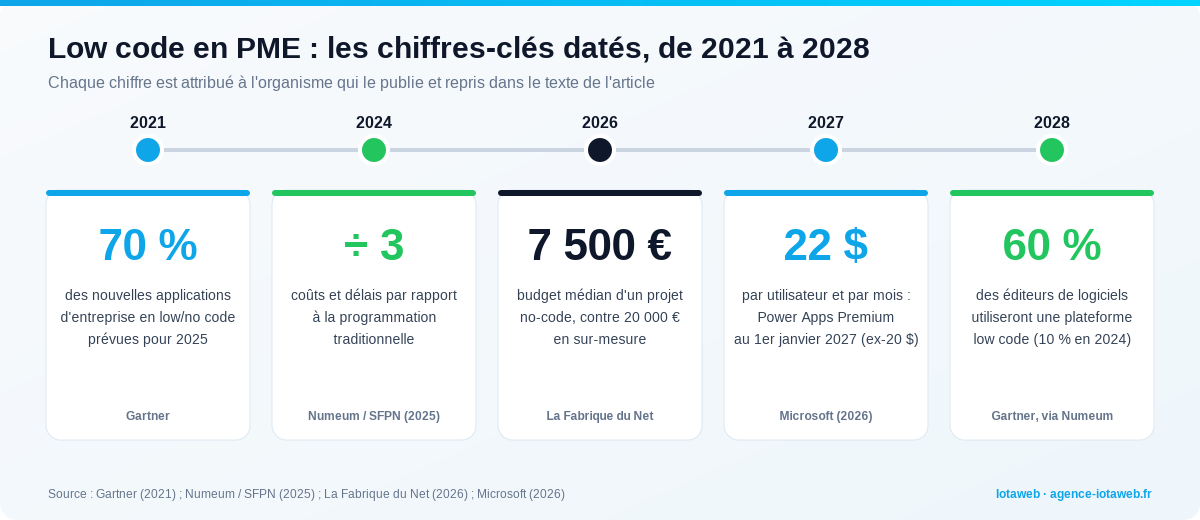
Low-code development is suitable for an SME when the tool to be built follows a standard process, serves fewer than a hundred users, and needs to be operational within a few weeks: the median budget for a no-code project is €7,500 compared to €20,000 for a custom solution, according to La Fabrique du Net (2026). It reaches its limits as soon as the application becomes the core of the business, when the licensing costs increase with the number of users, or when a key function no longer fits within the platform: this is where a custom solution, or a WordPress hybrid, regains the advantage.
In summary: Three published figures frame a low-code project in an SME.
The Internet Factory, 2026
Numeum / SFPN, 2025
Gartner, 2021
Microsoft also announced that Power Apps Premium will increase from $20 to $22 per user per month on January 1, 2027 (Microsoft, 2026): the recurring cost is calculated before signing.
📋 Summary
- What is low-code development for an SME?
- How much does low-code development cost for an SME in 2026?
- What are the limitations of low code for an SME?
- Method: Deciding between low-code and custom-built solutions in 5 steps
- When should an SME switch from low code to custom-made solutions?
- What will change in 2026 for low-code in business?
- Why entrust your low-code project to Iotaweb?
- FAQ — Low-code development for an SME
What is low-code development for an SME?
Low-code development refers to building an application from a visual platform (ready-to-use components, drag-and-drop functionality, workflows), with the option to add code for specific use cases. No-code development is the variant that eliminates all coding and is aimed directly at business teams; the NoCode Summit report, co-published by Numeum and the French No-Code Professionals Association (SFPN) in 2025, uses the term «visual programming» to refer to both. Custom development, on the other hand, involves writing the application's source code in a standard language (PHP, JavaScript, Python): the company owns this code.
For SMEs, low-code primarily serves to replace spreadsheets and paper-based processes: tracking interventions, validating quotes, creating customer portals, and managing dashboards. The Numeum/SFPN report (2025) cites a Gartner forecast: 60% of software development companies will use a low-code platform in 2028, compared to 10% in 2024.
How much does low-code development cost for an SME in 2026?
A low-code or no-code project costs a median of €7,500 excluding subscriptions, compared to €20,000 for custom development, according to 67 no-code budgets and 944 web development budgets published on La Fabrique du Net (2026); half of the no-code projects are between €5,000 and €15,000, while a quarter of the custom projects exceed €50,000. The Numeum/SFPN report (2025) predicts a reduction of approximately two-thirds in costs and time compared to traditional programming.
| Approach | Initial reference budget | Recurring costs | Property and exit | For which SME project |
|---|---|---|---|---|
| 🧩 No code (Bubble, Airtable, Glide) | Median €7,500 (La Fabrique du Net, 2026) | Subscription per user or per usage volume, increasing with traffic | ✗ Configuration hosted by the publisher, no source code | Internal tool, prototype, simple portal |
| ⚙️ Low code (Power Apps, Mendix, WeWeb) | Between no-code and custom-built depending on the level of code added (no median published) | Per-user licenses: Power Apps Premium $22 per month as of January 1, 2027 (Microsoft, 2026) | ◐ Partial; some tools export code (WeWeb, FlutterFlow) | Business application integrated into the IT system, team using Microsoft 365 |
| 🛠️ Custom-made (PHP, JavaScript) | Median €20,000, a quarter over €50,000 (La Fabrique du Net, 2026) | Hosting and maintenance, without a per-user license | ✓ Source code and data belong to the company | Product that generates revenue, unique business rules |
| 🔗 Hybrid WordPress + automation | Variable depending on the modules; custom plugin on an open source platform | Hosting, WordPress maintenance, Make or Zapier subscription as applicable | ✓ PHP code delivered, data in exportable MySQL database | Online quotes, customer area, catalog, forms connected to the CRM |
The cost to compare is that of the first three years: development, subscriptions, and upgrades. La Fabrique du Net (2026) points out that low-code subscriptions increase with users and server consumption, and cites Bubble's switch to usage-based billing in April 2023, which increased the cost of data-intensive applications. For the automation section, see our page low-code and no-code automation with Make and WordPress details the connectors we are putting in place.
🧭 Low code, custom-made or hybrid WordPress: which one for your SME?
Anthony Menard, Iotaweb — Guingamp, Côtes-d'Armor (22) · 3-year cost estimate delivered with each quote
What are the limitations of low code for an SME?
The limitations of low-code can be summarized in five points: a wall of complexity, price dependency, incomplete reversibility, a «black box» effect, and governance risks. The Numeum/SFPN report (2025) documents these: when needs exceed the platform's capacity, maintenance becomes difficult; a change in pricing structure has been shown to increase the cost of an application tenfold (Smile case study); and there is no automatic way to migrate a low-code application to another solution, a point highlighted by AFNOR Spec 2312.
The Factory of the Net (2026) adds a layer of abstraction which slightly reduces raw performance, and very complex applications which become a visual «Rube Goldberg machine» that is difficult to maintain.
Method: Deciding between low-code and custom-built solutions in 5 steps
The decision-making process involves five steps: defining the need, estimating costs over three years, testing the limits on a prototype, verifying the release conditions, and then making a final decision and documenting the project. This is the framework Iotaweb applies before each quote.
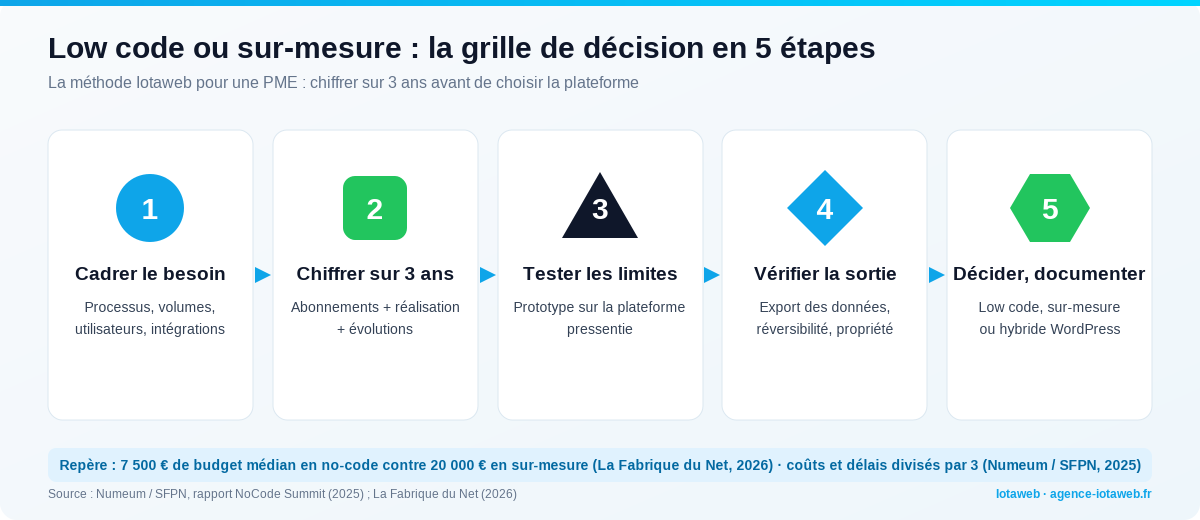
🛠️ The 5 steps of the decision grid
- Define the need. Processes, data volumes, internal and external users, tools to connect (CRM, accounting, messaging).
- To quantify over three years. Implementation + subscriptions per user and per use + upgrades; compare to a custom-made solution amortized without a license.
- Testing the limits. A short prototype on the proposed platform reveals the impossible functions before committing the budget.
- Check the output. Full data export, exportable or non-exportable code, termination clauses.
- Decide and document. Written choice, designated manager, governance rules against Shadow IT (AFNOR Spec 2312, 2024).
When should an SME switch from low code to custom-made solutions?
An SME should consider switching to a custom solution as soon as three of seven signs appear simultaneously: slow load times, escalating costs with usage, unusable functionality, fragile integrations, captive data, a product that generates revenue, and a time horizon of more than five years. The Edana agency (2026) describes the first signs: pages and automations that slow down during peak periods, stacked connectors that conflict, and a return on investment for custom code of 18 to 24 months.
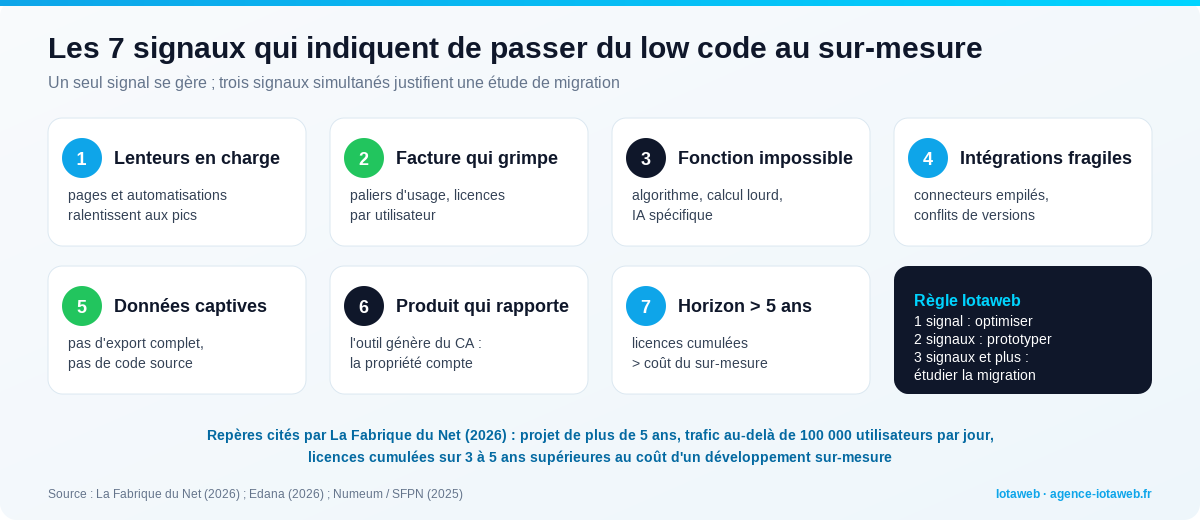
The Fabrique du Net (2026) sets benchmarks for favoring custom solutions: a budget exceeding €30,000, a project planned over five years, traffic exceeding 100,000 users per day, or cumulative licenses over three to five years that exceed the cost of development. A validated MVP developed using no-code and then rebuilt as a V2 remains a sound trajectory, as with this example. custom-developed B2B prospecting platform using WordPress.
Should you choose a custom-made solution from the start?
No, unless the product is the core of the business model or relies on a proprietary algorithm. For an internal tool or a standard portal, low-code or WordPress hybrid development remains the cheapest option over three years; our comparison no-code versus traditional development details the timelines by project type.
What will change in 2026 for low-code in business?
Three developments will impact a small or medium-sized enterprise's (SME) low-code budget in 2026: rising Microsoft license fees, a French best practices framework, and expanded accessibility requirements. Microsoft has announced that Power Apps Premium will increase from $20 to $22 per user per month for any purchase or renewal starting January 1, 2027 (Microsoft, 2026): an SME with 40 users must factor this increase into its three-year budget.
AFNOR Spec 2312, published in July 2024 at the initiative of the SFPN (French Digital Services Association), is a 46-page document that emphasizes governance to prevent Shadow IT; AFNOR presents it as a first step towards an ISO standard (Le Monde Informatique, 2024). Finally, the Numeum/SFPN report (2025) reminds us that digital accessibility obligations apply to new services from June 25, 2025: an application delivered to customers must be verified on this point. This is not legal advice.
Why entrust your low-code project to Iotaweb?
Iotaweb is a low code development agency Based in Guingamp, Côtes-d'Armor (22), the company employs three approaches: low-code platforms and Make or Zapier automation, custom WordPress and WooCommerce plugins in PHP, and hybrid solutions where WordPress serves as an open-source foundation for business tools. Each quote includes a three-year cost estimate and a list of data exports. Once the tool is online, Anthony Ménard also provides support in freelance Google Ads to bring customers to it.
FAQ — Low-code development for an SME
No-code applications are managed entirely through a visual interface, without writing any code, and are intended for business teams; low-code applications require technical knowledge and allow for the addition of code for specific cases, according to the Numeum/SFPN report (2025). SMEs typically choose no-code for a simple internal tool and low-code when the application needs to integrate with their existing information system.
The median budget for a no-code project is €7,500, with half of the projects falling between €5,000 and €15,000, compared to €20,000 for custom development, according to La Fabrique du Net (2026). Subscriptions must be added to this: Power Apps Premium will cost $22 per user per month starting January 1, 2027 (Microsoft, 2026).
The risks documented by the Numeum/SFPN report (2025) include the complexity barrier when the need exceeds the platform, price dependency (a change in pricing structure increased the cost of an application tenfold), the lack of automatic migration to another solution, and the black box effect. AFNOR Spec 2312 (2024) adds Shadow IT, which only a written governance framework can prevent.
When three signals converge: slow load times, escalating costs, unusable features, fragile integrations, captive data, a product generating revenue, and a time horizon of more than five years. La Fabrique du Net (2026) cites as benchmarks a project lasting more than five years, traffic exceeding 100,000 users per day, or cumulative licenses over three to five years exceeding the development cost.
In conclusion, low-code development is the right choice for an SME when the tool follows a standard process, the number of users remains manageable, and the exit conditions are verified before signing. Custom development, or a WordPress hybrid, takes over as soon as the application generates revenue, outgrows the platform, or costs more in cumulative licenses than a fully amortized development.
🚀 A business tool with a 3-year cost estimate, low-code or custom-built
Anthony Menard — Iotaweb, Guingamp (22) · since 2012 · detailed quote without obligation
📚 Also read
Sources: Numeum / SFPN — Low Code/No Code, a lever for digital transformation, official report of the NoCode Summit (2025) · La Fabrique du Net — Low-code or custom development for your business? (2026) · Microsoft Licensing — Power Apps Premium price update (2026) · Gartner — Cloud Will Be the Centerpiece of New Digital Experiences, press release dated November 10, 2021 · Le Monde Informatique — AFNOR introduces best practices for low/no code (AFNOR Spec 2312, July 2024) · Edana — Migrating from no-code to code: when your product truly becomes a business (April 2026) · Journal du Net — The impact of low code / no code on the adoption of technologies by French SMEs (2024)
See also
 Price of a website for a craftsman in Brittany in 2026: the actual price rangeArtisan website prices in Brittany 2026: sourced ranges, 6 cost items, regional aid 30 % and legal obligations to compare two quotes.
 Zapier and Make automation serviceDiscover IOTAWEB's Zapier Make automation service: CRM, ERP, leads, API. Create high-performance automated workflows with an expert.Create your love room website with IotawebIotaweb creates your love room website with online booking, synchronized calendar, and local SEO. Starting from €1,000 excluding VAT. Free quote.
Entrust me with your project
Describe it in a few lines. You will receive a response and a free quote within 24 hours.